
Introduction
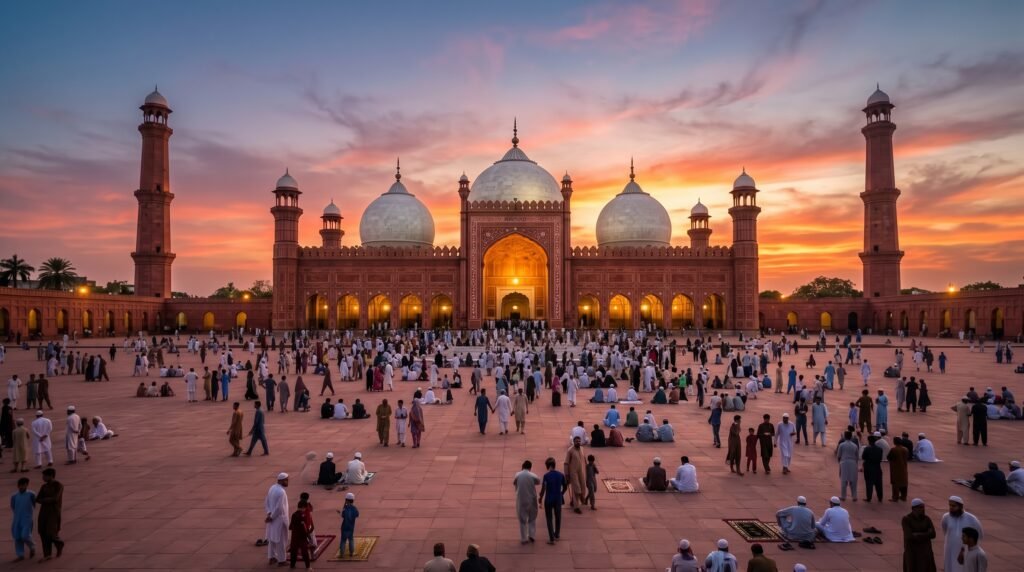
The Badshahi Mosque is one of the historical place is located in Lahore in province of the Punjab. It is second largest mosque in Pakistan. It was built by Mughal Era in sixth Mughal Emperor, Aurangzeb Alamgir, in 1671. The Badshahi Mosque with red sandstones and domes with white marbles which give visitors to beautiful atmosphere.
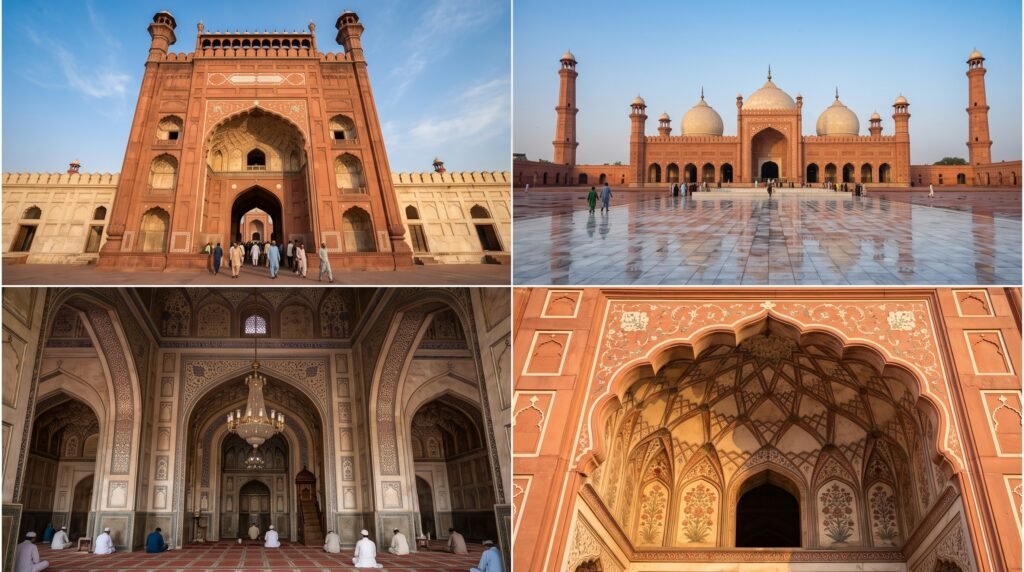
If you are searching for a Badshahi Mosque Photo, you will find many different views of this historic mosque. Some photos show the complete building from the front, while others focus on the domes, minarets, entrance, courtyard, and beautiful architectural details.
It’s marvelous beauty catches the eye of many travelers and it feels like you are standing in a timeline of Mughal Era. It is the largest mosque built by Mughals. This article covers it’s historical significance, history, architecture, Islamic treasures and visiting guide.
History
- Mughal Era: The sixth Mughal Emperor Aurangzeb Alamgir to spot his success in overcoming South Indian region, in 1671. This mosque was built opposite to Lahore Fort and the construction was managed by his foster brother and Governor of Lahore at that time, Fidai Khan Koka.It’s rapid construction come to an end in just two years, 1673. Badshahi Mosque remained the largest mosque in the world for over three hundred years and kept it’s title till Faisal Mosque, Faisalabad was built.
- Sikh Era: In 1799, Sikh Emperor Maharaja Ranjit Singh became the controller/ruler of Lahore. He used the huge courtyard as stables for the horses and 80 Hujras (small rooms around courtyard) as military storage and for soldiers to live. During clashes of Sikh rulers, in 1841, Zamburaks (small gun or spotlight) was installed on tall minarets to bombard their opponents in Lahore Fort. The inner Hall was destroyed during these clashes and a tunnel was also built connecting Badshahi Mosque and Lahore Fort for military purposes.
- British Era: British Rule also continued using Badshahi Mosque for military purposes in 1849. The damage caused during years of conflicts was rebuilt during British Era. The red sandstone and domes was also damaged and it was restored in 1939 and was handed back to Muslims after they show concern for this mosque to be used as a place for worship for Muslims.
- Post Independence: The restoration work that was started in 1939 continues and gets completed in 1970 after Pakistan gained independence in 1947. Government spent 4.8 million rupees, a huge amount at that time to rebuilt Badshahi Mosque to it’s original Mughal state. The damaged red sandstone was also restored.
- For OIC Islamic summit, on February 22, 1974 Muslim leaders of 39 nations gathered and prayed Friday prayer together. Personalities like Faisal of Saudi Arabia, Zulfiqar Ali Bhutto, Muammar Gaddafi and Yasser Arafat were included. Other than that, Queen Elizabeth II, Princess Diana and Prince William also visited this mosque.
Location
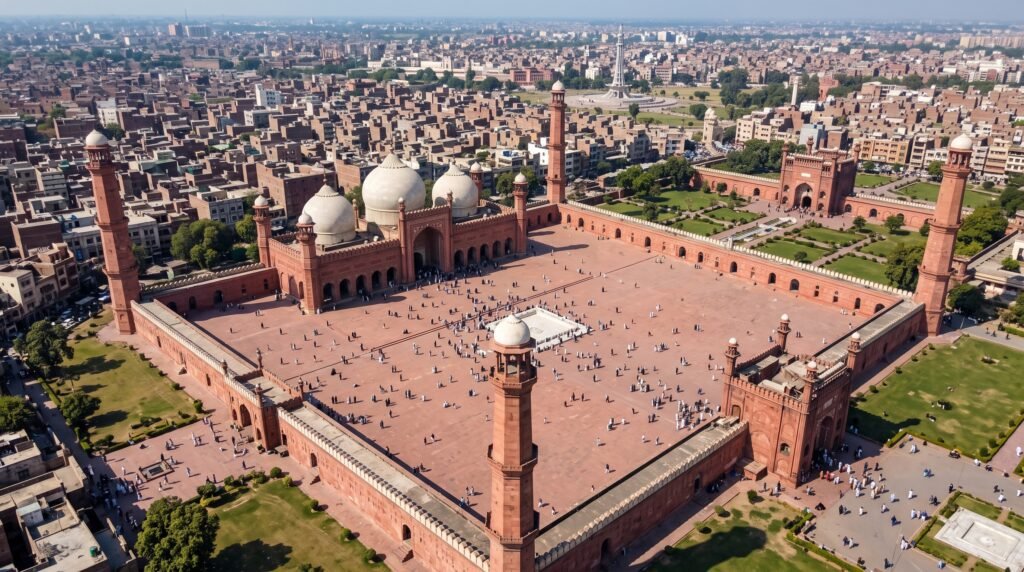
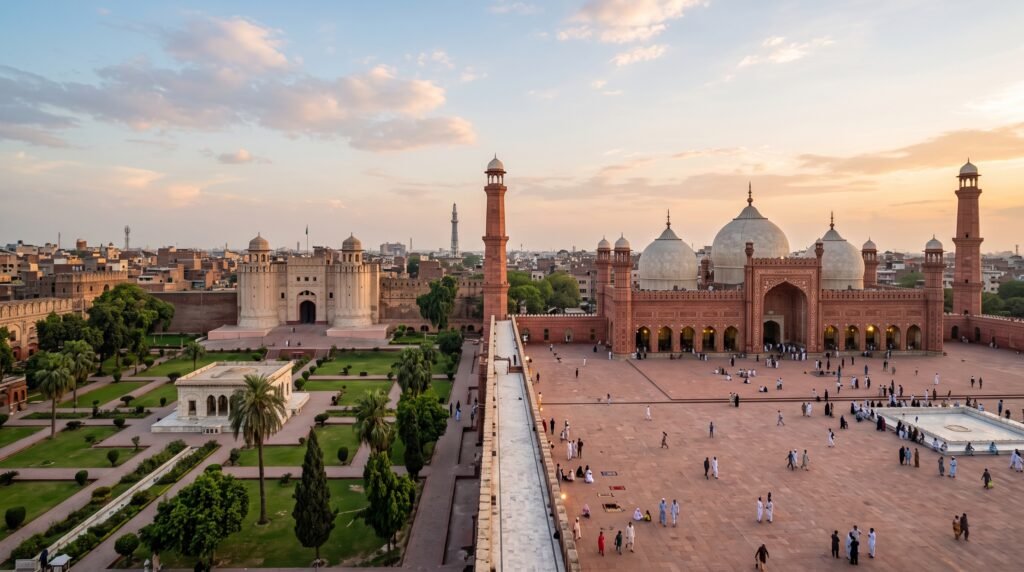
The Badshahi Mosque is located in the center of Lsahore city and opposite to Lahore Fort, along with Minar-e- Pakistan and Ferozpur Road. Here is Google Map Locaion. Hazuri Bagh, a garden lies between Badshahi Mosque and Lahore Fort. Minar-e-Pakistan, which marks the location where Lahore Resolution was passed, is also located near Badshahi mosque. Shahi Qila is also located adjacent to Badshai Mosque. Some rooftop restaurants on Food street Fort Road provides a gorgeous view of red sandstone and enlighten domes at night.
Architecture and Design
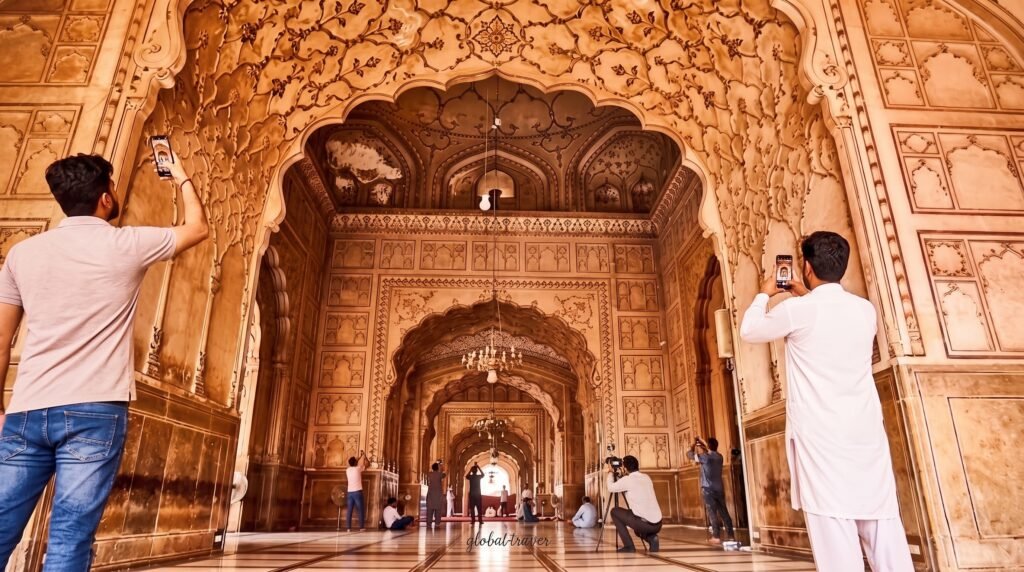
- The walls of Badshahi Masjid are carved with red sandstone brought from Rajasthan and it is responsible for the warm aesthetic of mosque. White marble is used on the inside of mosque combined with lattice work and decorative borders on walls and inner side of domes. The three main domes are made of white marble which creates a great contrast with red sandstone.
- Aurangzeb’s foster brother Fidai Khan Koka managed the constructor and supervise the architecture of Badshahi Mosque. The architecture was hugely inspired by Jamia Masjid, Dehli that was built in reign of Shah Jahan, father of Aurangzeb. The construction completed with a remarkable speed and thousands of workers in just two years.
Capacity
- Main Hall: This inner main hall chamber is divided into seven grand divisions and can occupy almost 10,000 worshipers at a time. This inner hall is for daily prayers and Friday prayers. The hall is designed with white marble and prayer mats.
- Courtyard: The massive 25,600 square meter area in the courtyard can absorb almost 90,000 to 100,000 worshipers and is one of the huge courtyard in the world. The number of worshippers extend from start of hall to end of main gate during Eid-ul-Adha and Eid-ul-Fitr.
- Hujras: The Hujras or small rooms also serves an additional area for worshippers in rainy or extreme sunny weather allowing more people to worship.
Layout
- Main Entrance: The main gate faces Lahore Fort to east. It has 22 steps made of red sandstone and are decorated by small minarets.
- Open Courtyard: its courtyard is in a square shape of 530 ft by 530 ft. An ablution area is located at the center of courtyard. Worshippers use this place for making ablution (wudu) before offering prayer.
- Hujras: The courtyard is surrounded by 80 Hujras on east, north and south side. The Hujras serves as rooms or shelters for students and scholars.
- Main chamber: The main chamber has three outer domes, one of which is slightly bigger than other two and made of white marble with floral word/design and from the inside it is divided into seven other bays. It is designed with marble work and faced to west or Makkah.
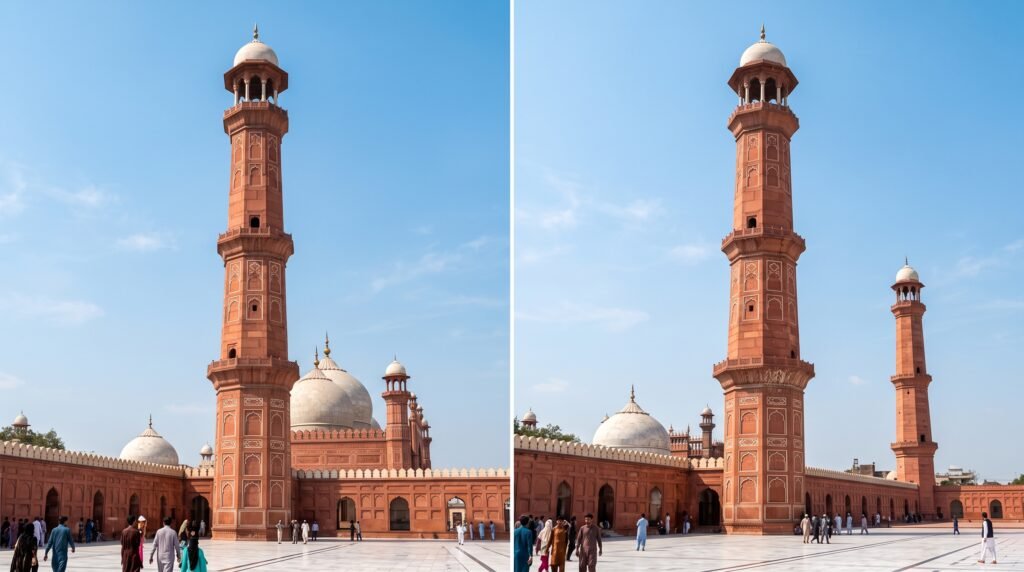
- Minarets: There are four primary minarets at every corner of Badshahi Mosque, every Minar is 177 ft tall. Four minarets are also at each corner of main hall.
Relics/Tabarrukat
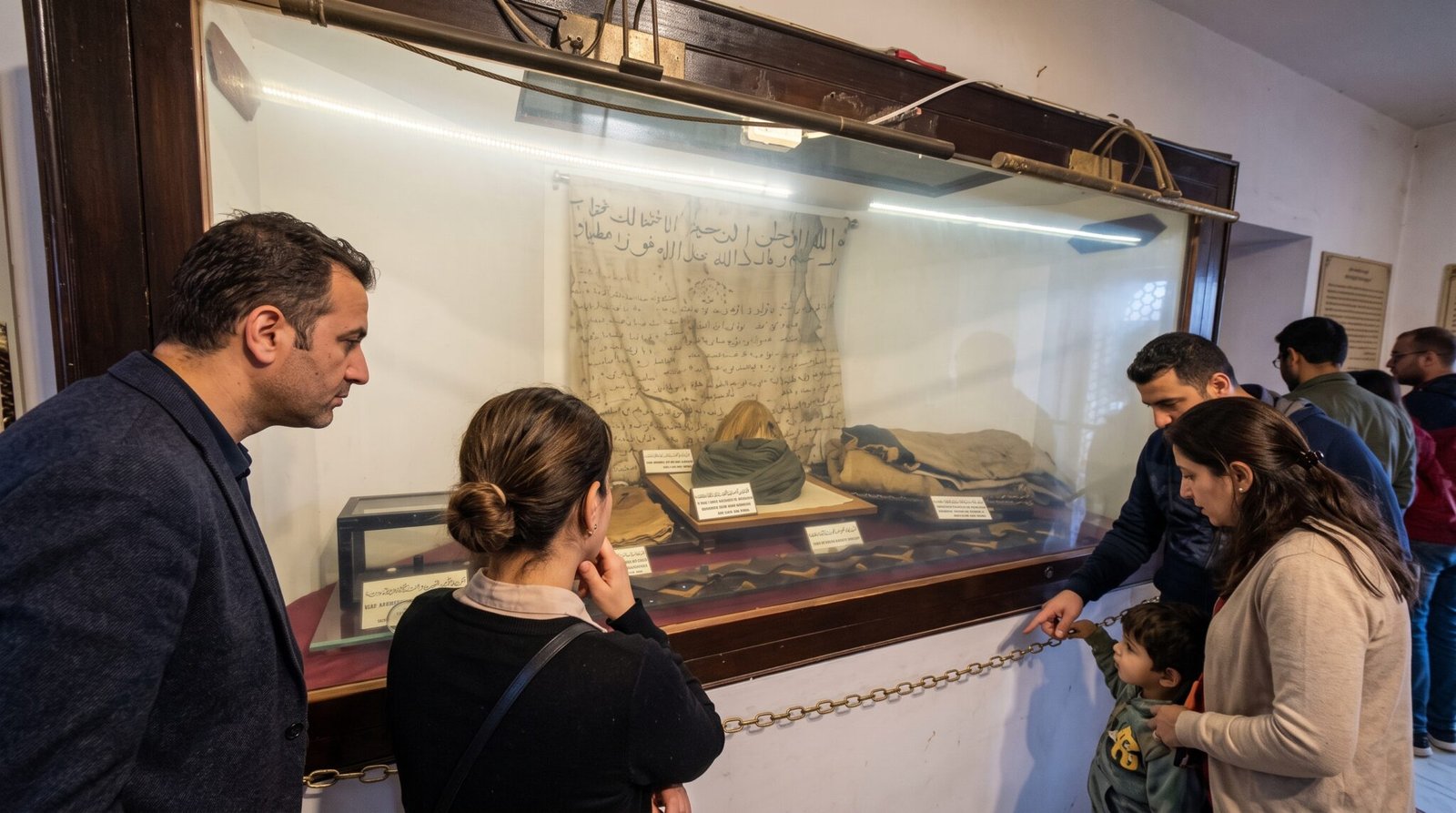
Many Relics related to Hazrat Muhammad (PBUH) are reserved. Sacred strands of hair in glass, footprints on stone, green Turban, green coat and white trouser, a prayer mat and an Islamic banner with sacred verses of Quran.
Ahly-bait relics are also reserved such as Turban (Amama) of Hazrat Ali (R.A), the fourth caliph of Islam and certain items related to Hazrat Fatima (R.A) and the grandson of Hazrat Muhammad (PBUH), Hazrat Hussain (R.A) are present.
Sacred handwritten copies of Quran and calligraphy written by Mughals themselves.
Entry Fee
- Entry: The entry to Badshahi mosque is free and no ticket is required for both locals and foreign visitors.
- Shoe Counter: As people should remove their shoes before entering the masjid, there are shoe counters at entrance so you can give them your shoes for safety and the fee is almost 20 to 50 rupees.
- Parking: There is an area right next to mosque where you can park your vehicles. Charges for vehicles are, 30 to 50 rupees and for cars it’s 100 to 150 rupees.
Bring your money I cash as cards are not valid in this area.
Prayer Timings
Summer (April to September)
- Fajar – 4:15am to 4:45am (or earlier at start of summer)
- Zuhr – 1:00pm to 1:45pm
- Asar – 4:45pm to 5:30pm
- Maghrib – 6:30pm to 7:30pm (5 to 7 minutes after Sunset)
- Isha – 8:30pm to 9:15pm
- Namaz-e-Jumma – 1:00pm to 2:00pm
Winter (November to March)
- Fajar – 5:15am to 6:15am (depending on dawn)
- Zuhr – 1:00pm to 1:45pm
- Asar – 3:45pm to 4:30pm
- Maghrib – 5:00pm to 5:45pm (5 to 7 minutes after Sunset)
- Isha – 7:00pm to 8:00pm
- Namaz-e-Jumma – 1:00pm to 2:00pm
Dressing Style
People should dress modest if they go to Badshahi Mosque. Women can bring scarf, wear loose dresses and avoid wearing too much tight or see through dresses and cover their arms and legs. Men should wear Shalwar Kameez and T-shirts, long pants or trousers. Must remove shoes before entering the mosque.
Badshahi Mosque Photo with Surroundings
- Hazuri Bagh: It is situated ate the main gate of Badshahi Mosque and Lahore Fort. It is a green garden and has a central Hazuri Bagh Baradari where visitors can sit and take photos.
- Lahore Fort: It is directly opposite to the main gate of Badshahi Mosque and this is also a historical landmark.
- Allama Iqbal Tomb: It is the tomb of Pakistan’s national poet Allama Muhammad Iqbal and this tomb is located at the right side of Badshahi Mosque. This tomb is also made with red sandstone.
- Minar-e-Pakistan: Minar-e-Pakistan is also located near Badshahi mosque. This is also a historic landmark to mark the location where Lahore Resolution was passes in 1940.
- Greater Iqbal Park: A huge park is located at north side of Badshahi Mosque where many tourists come.
- Food Street: There is a food street from a short distance to Badshahi mosque where a number of Havelis offer traditional foods with a dining at rooftop providing a fantastic view of illuminated domes of mosque at night. They serve Biryani, Karahi and many more.
Best Time to Visit
- Weekdays and Time: Weekdays are also recommended due to lower number of visitors. So, you can enjoy and spend time without any hustle and heavy crowds. The traffic increases during weekends as people are free and want to visit somewhere. However, evenings are best for photography and for dreamy outdoor photos as it adds an extra beauty to mosque. During prayer times, do not enter the main hall as the people are offering prayers and they will get distracted.
- Season: Summer in Lahore is very hot and if you want to avoid the heat waves and exhaustion then winter would be the best choice for you.
Conclusion
At last, Badshahi Mosque, Lahore is a remarkable monument built by Aurangzeb. It symbolizes the historic architecture of Mughals. It is made with white marble and red sandstone with a capacity of almost 100,000 worshippers. The immense hall and courtyard gives you the main character vibe and let you down into history. People offering payers shows the exemplary discipline of Muslims.
This mosque is holding the most sacred items of Islamic Era that belongs to Hazrat Muhammad (PBUH), Hazrat Ali (R.A), Hazrat Fatima (R.A) and Hazrat Hussain (R.A). Many people visit this mosque every day and once again recall history. This mosque was once the largest mosque in the world. This mosque should take a place in your visit list. Must visit this mosque to feel the aesthetic and to blend into history!
Frequently Asked Questions (FAQ’s)
Where is Badshahi Mosque located?
he Badshahi Mosque is located in the center of Lsahore city and opposite to Lahore Fort, along with Minar-e- Pakistan and Ferozpur Road.
Can I take photos at Badshahi Mosque?
Photography is allow, but visitors should follow the mosque’s current rules and respect worshippers and religious activities.
What is the best time for photography?
Morning and evening can provide softer light. The best time also depends on the weather and visitor crowd.
What is the best view for a Badshahi Mosque Photo?
The front view, courtyard, domes, minarets, and the view with Lahore Fort are all useful options.
Is Badshahi Mosque good for smartphone photography?
Yes. You can take good photos with a smartphone by choosing a good angle, keeping the lens clean, and using natural light.


Pingback: Science Museum Lahore: 10 Amazing Things And Tips To Know